


Managing transfer student enrollment can feel overwhelming when each college faces unique demographic shifts and increasing expectations for quicker, more accurate credit evaluation. This challenge is driving community colleges across the United States to rethink traditional strategies and seek out innovative solutions. By adopting Strategic Enrollment Management approaches that combine data analytics, cross-departmental collaboration, and advanced AI tools, enrollment leaders can create a more adaptive, student-centered experience from recruitment through graduation.
Table of Contents
- Defining Enrollment Management Strategies
- Key Types Of Enrollment Management Approaches
- How AI Transforms Transfer Student Enrollment
- Optimizing Student Engagement And Recruitment
- Financial And Compliance Implications Of Modern Tools
- Common Pitfalls And How To Avoid Them
Key Takeaways
| Point | Details |
|---|---|
| Strategic Enrollment Management (SEM) | SEM requires collaboration across departments, focusing on the entire student lifecycle for effective recruitment and retention. |
| Data-Driven Approaches | Utilizing advanced analytics improves decision-making and enhances student engagement strategies. |
| Integration of AI | AI technologies streamline processes and enable personalized communication for better student recruitment. |
| Avoiding Common Pitfalls | Institutions must ensure data integration and staff training to overcome challenges in technology adoption. |
Defining Enrollment Management Strategies
Strategic Enrollment Management (SEM) represents a comprehensive, data-driven approach that higher education institutions use to systematically address student recruitment, retention, and graduation goals. Strategic planning processes emerged in response to increasingly complex student markets and recruitment challenges, requiring colleges to develop sophisticated, integrated strategies for sustainable growth.
At its core, SEM involves cross-functional collaboration across multiple institutional departments, integrating recruitment, academic support, financial aid, and student services into a unified framework. The approach goes beyond traditional admissions tactics by examining the entire student lifecycle, from initial interest through graduation. Institutions utilizing SEM recognize that successful enrollment management requires understanding complex demographic trends, leveraging technological tools, and creating personalized student engagement strategies.
Modern SEM strategies incorporate advanced data analytics to predict enrollment patterns, identify potential student segments, and develop targeted outreach programs. These strategies enable colleges to make informed decisions about resource allocation, academic program development, and student support services. By analyzing historical enrollment data, demographic shifts, and student success metrics, institutions can create adaptive approaches that respond dynamically to changing educational landscapes.
Pro tip: Develop a comprehensive data dashboard that integrates enrollment, retention, and student success metrics to enable real-time strategic decision-making across your institution.
Key Types Of Enrollment Management Approaches
Strategic Enrollment Management encompasses multiple approaches designed to holistically address institutional growth and student success. Organizational planning models reveal several critical types of enrollment strategies that institutions can implement to optimize their student recruitment and retention efforts.
The primary enrollment management approaches include recruitment-focused strategies, retention-driven models, and integrated comprehensive frameworks. Recruitment strategies concentrate on attracting prospective students through targeted marketing, personalized outreach, and comprehensive communication plans. Retention models prioritize student support services, academic interventions, and proactive advising to improve persistence and graduation rates. Integrated comprehensive frameworks combine these approaches, creating a seamless system that addresses student needs from initial inquiry through graduation.
Modern enrollment management approaches increasingly leverage data analytics and technological tools to enhance decision-making. These sophisticated models involve predictive modeling, segmentation strategies, and adaptive communication techniques that allow institutions to develop nuanced, personalized approaches to student engagement. By analyzing historical enrollment data, demographic trends, and student success metrics, colleges can create dynamic strategies that respond quickly to changing educational landscapes and student expectations.
Here’s a comparison of the main enrollment management approaches and their core focus:
| Approach Type | Primary Goal | Key Focus Areas |
|---|---|---|
| Recruitment-Focused | Grow new student enrollment | Targeted marketing, outreach |
| Retention-Driven | Improve student persistence | Support services, advising |
| Integrated Comprehensive | Optimize full lifecycle | Unified framework, data analytics |
Pro tip: Develop a cross-departmental enrollment management team that meets regularly to share insights, align strategies, and create unified approaches to student recruitment and retention.
How AI Transforms Transfer Student Enrollment
Artificial Intelligence is dramatically reshaping the landscape of transfer student enrollment, offering unprecedented opportunities for personalized engagement and strategic recruitment. Transformative AI technologies are enabling institutions to develop more sophisticated, data-driven approaches to identifying, attracting, and supporting transfer students throughout their academic journey.
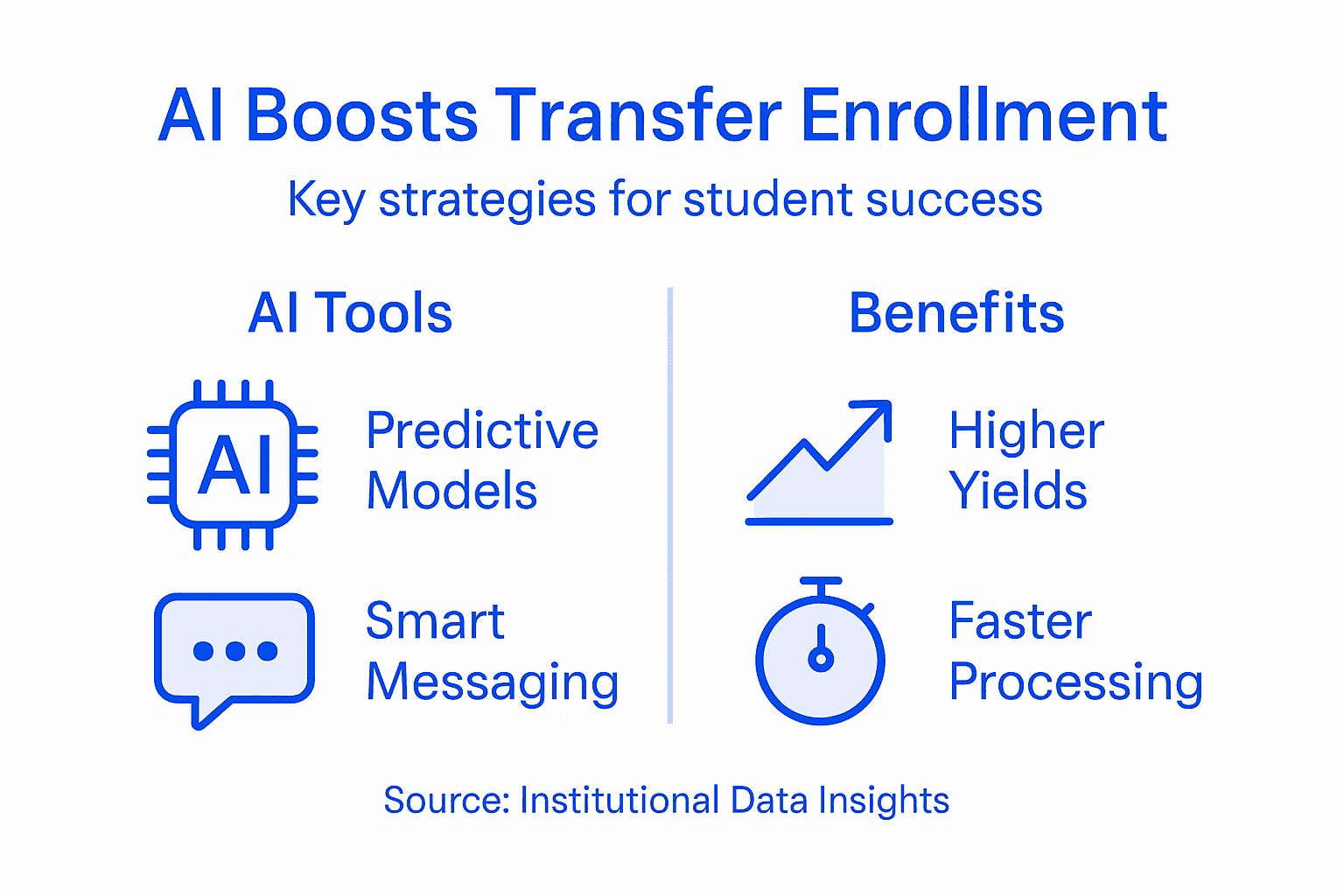
The most significant AI-driven transformations occur in three critical areas: predictive analytics, personalized communication, and administrative efficiency. AI-powered predictive models can now analyze complex student data to identify potential transfer candidates with remarkable accuracy, mapping their academic trajectories and predicting likelihood of success. These systems can evaluate transfer credit potential, recommend optimal academic pathways, and proactively identify students who might benefit from targeted intervention or support services. Personalized communication tools powered by machine learning algorithms can craft individualized outreach messages, addressing specific student concerns and motivations with unprecedented precision.

Moreover, AI is revolutionizing the administrative aspects of transfer student enrollment by automating time-consuming processes like transcript evaluation, credit transfer assessments, and application tracking. These technological innovations significantly reduce manual workload, minimize human error, and create more streamlined, responsive enrollment experiences. By integrating advanced machine learning techniques, institutions can now develop adaptive systems that continuously improve their understanding of transfer student dynamics, enabling more strategic and nuanced recruitment approaches.
Explore how AI enhances transfer student enrollment below:
| AI Capability | Enrollment Benefit | Example Application |
|---|---|---|
| Predictive Analytics | More accurate candidate targeting | Mapping academic journeys |
| Personalized Communication | Higher engagement rates | Tailored outreach messages |
| Administrative Automation | Improved process efficiency | Automated transcript evaluation |
Pro tip: Implement a cross-functional AI task force that includes enrollment managers, academic advisors, and technology experts to develop ethical, strategic AI integration strategies for transfer student recruitment.
Optimizing Student Engagement And Recruitment
Successful student recruitment requires a strategic, multifaceted approach that combines advanced technological capabilities with personalized human connections. Student engagement strategies have evolved dramatically, demanding institutions develop sophisticated approaches that address the complex needs of modern transfer students.
The core of effective recruitment lies in creating a comprehensive engagement ecosystem that leverages data-driven insights and targeted communication. Modern institutions must develop nuanced outreach strategies that go beyond traditional marketing approaches, utilizing predictive analytics to identify potential transfer students and craft personalized communication pathways. This involves analyzing student data points such as academic performance, career aspirations, financial considerations, and individual learning preferences to create highly targeted recruitment messages that resonate on a personal level.
Technological innovation plays a crucial role in optimizing student recruitment and engagement. Advanced customer relationship management systems, artificial intelligence-powered communication platforms, and sophisticated data analytics tools enable institutions to create dynamic, responsive recruitment strategies. These technologies allow for real-time tracking of student interactions, predictive modeling of enrollment potential, and the development of adaptive communication strategies that can quickly respond to individual student needs and institutional enrollment objectives.
Pro tip: Develop a comprehensive student engagement dashboard that integrates multiple data sources to create holistic, personalized recruitment and retention strategies.
Financial And Compliance Implications Of Modern Tools
Navigating the complex landscape of technological innovation requires a sophisticated understanding of financial and regulatory challenges. Compliance risk management has become increasingly intricate as higher education institutions integrate advanced technological solutions into their enrollment management strategies.
The financial implications of modern enrollment tools extend far beyond simple cost considerations. Institutions must carefully evaluate the potential return on investment, balancing technological implementation costs with long-term efficiency gains and potential revenue improvements. This involves conducting comprehensive cost benefit analyses that account for not just direct technological expenses, but also potential savings from improved operational efficiency, reduced manual processing, and more targeted student recruitment strategies.
Regulatory compliance presents another critical dimension of technological adoption. Higher education institutions must develop robust frameworks that ensure data privacy, protect student information, and maintain transparency in technological applications. This requires ongoing collaboration between technology teams, compliance experts, and academic leadership to create adaptive systems that meet evolving regulatory standards while maintaining the flexibility to leverage cutting-edge technological innovations.
Pro tip: Establish a cross-functional compliance review committee that meets quarterly to assess technological tools, evaluate regulatory risks, and develop proactive mitigation strategies.
Common Pitfalls And How To Avoid Them
Implementing advanced enrollment management technologies involves navigating a complex landscape of potential challenges that can derail strategic initiatives. Work-related productivity challenges demonstrate that institutional success depends on proactively identifying and mitigating potential obstacles before they significantly impact enrollment strategies.
One of the most critical pitfalls involves inadequate data integration and technological compatibility. Many institutions struggle with siloed systems that prevent comprehensive student insights, leading to fragmented decision making. Successful enrollment management requires robust technological infrastructure that enables seamless communication between student information systems, customer relationship management platforms, and analytics tools. Organizations must invest time in thorough system assessment, prioritizing interoperability and developing clear data migration strategies that maintain information integrity.
Another significant challenge emerges from insufficient staff training and technological resistance. Even the most sophisticated enrollment management tools can fail without proper organizational adoption. Institutions must develop comprehensive change management strategies that include extensive staff training, transparent communication about technological benefits, and creating opportunities for ongoing skill development. This approach helps overcome institutional inertia and builds a culture of technological adaptability that supports long-term strategic goals.
Pro tip: Conduct comprehensive technology readiness assessments before implementation, including staff surveys and pilot testing to identify potential adoption barriers.
Unlock Transfer Student Enrollment Success with AI-Driven Solutions
The article highlights the complex challenges in transfer student recruitment including the need for predictive analytics, personalized communication, and streamlined administrative processes. Many institutions struggle with managing high volumes of transcripts, evaluating transfer credits accurately, and engaging prospective students quickly while reducing manual workload. These pain points often lead to fragmented enrollment strategies and missed growth opportunities.
DegreeSight offers a cutting-edge platform designed to directly address these concerns by leveraging AI-powered automation and Transcript OCR technology. Our solution accelerates transcript processing, integrates effortlessly with SIS and CRM systems, and delivers fast, personalized responses to prospective transfer students. By automating credit evaluations and enabling real-time communication, enrollment and registrar teams can generate qualified leads, increase engagement, and ultimately boost transfer student enrollment.
Ready to transform your transfer enrollment strategy with advanced AI tools that align with your strategic enrollment management goals?
Explore how DegreeSight can enhance your recruitment efforts by streamlining credit transfers and improving student engagement. Visit our platform overview to discover the features trusted by enrollment teams nationwide. Don’t wait to harness AI for sustainable growth—start optimizing your transfer student enrollment today.
Frequently Asked Questions
What is Strategic Enrollment Management (SEM)?
Strategic Enrollment Management (SEM) is a data-driven approach that institutions use to manage student recruitment, retention, and graduation, focusing on the entire student lifecycle.
How does AI enhance transfer student enrollment?
AI enhances transfer student enrollment through predictive analytics that identify potential candidates, personalized communication that engages students, and administrative efficiencies that streamline processes.
What are the key components of an effective enrollment management strategy?
An effective enrollment management strategy includes targeted recruitment efforts, retention-focused support services, and an integrated framework that combines data analytics and personalized engagement to address student needs.
What common challenges do institutions face when implementing enrollment management technologies?
Common challenges include inadequate data integration, technical compatibility issues, and insufficient staff training, which can hinder the successful adoption of advanced enrollment management tools.