

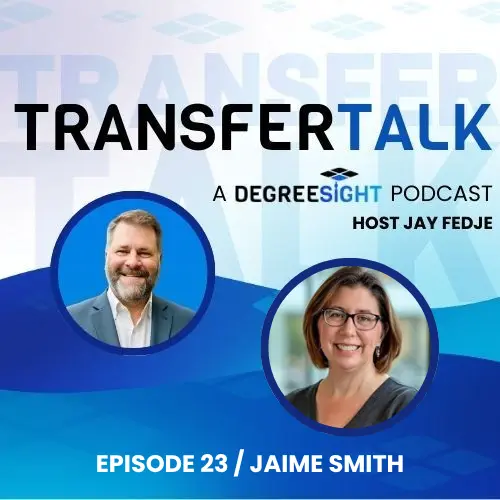
With Jaime Smith, Author of The Complete Guide to College Transfer
Transfer isn’t broken because students lack ambition, it’s broken because the system lacks clarity.
In this episode of TransferTalk, Jaime Smith brings a deeply human perspective to one of higher ed’s most complex challenges: helping students navigate a transfer journey that often feels more like a maze than a pathway.
Drawing on years of counseling experience, and the real stories behind her book, Smith challenges institutions to rethink how they serve today’s learners, especially those navigating multiple institutions, unclear credit policies, and inconsistent guidance.
The Transfer Journey Isn’t Linear Anymore
The traditional definition of a “transfer student” is quickly becoming outdated.
Today’s learners include:
- Dual-enrollment students graduating with college credits
- “Swirlers” moving across multiple institutions
- Adult learners returning after years away
- Students rebuilding their academic path after a wrong fit
“Transfers are harder to define now, some students are transfers at one school and freshmen at another.”
This complexity means institutions can no longer rely on rigid categories. Every student arrives with a unique story, and requires a more flexible, personalized approach.
From Pathways to Mazes
Smith describes two types of transfer experiences:
- Planned pathways → structured, predictable, efficient
- Swirling pathways → fragmented, uncertain, often inefficient
For too many students, the transfer process feels like navigating a maze, filled with dead ends, duplicated credits, and unclear next steps.
“Students are piecing together credits, hoping something works, but often losing time along the way.”
And the cost of that confusion isn’t just frustration, it’s lost time, lost money, and delayed degrees.
The Core Problem: Lack of Transparency
If there’s one theme that defines this episode, it’s transparency.
Smith makes a clear case: institutions must make transfer policies visible, understandable, and accessible, before students apply.
“Students need to know how their credits transfer and what comes next, not after they enroll, but upfront.”
Today, many institutions still:
- Hide transfer equivalencies
- Delay credit evaluations until after acceptance
- Provide confusing or inconsistent evaluation formats
This creates unnecessary friction at the most critical decision point.
Flip the Burden: Trust the Student’s Credits
One of the most powerful ideas in the conversation is simple, but transformative:
Assume credits are valid unless proven otherwise.
Currently, the burden falls on students to prove their coursework deserves credit, often requiring syllabi they no longer have.
“Students shouldn’t have to prove their credits are worthy, institutions should explain why they’re not.”
This shift would not only improve transparency, it would rebuild trust between students and institutions.
Technology Helps, But People Matter More
While tools and automation can improve efficiency, Smith is clear: they cannot replace human guidance.
“AI can guide, but it can’t replace the wisdom of a counselor who understands a student’s goals and context.”
Students need both:
- Technology for speed and access
- People for context, judgment, and empathy
The future of advising isn’t AI vs. humans, it’s AI + human guidance working together.
Enrollment Isn’t the Goal, Completion Is
Too often, institutions focus on getting students in the door.
But Smith challenges that mindset:
“It’s not about getting into college, it’s about getting through and graduating.”
For transfer students especially, success depends on:
- Clear degree pathways
- Accurate credit evaluations
- Ongoing advising support
Without these, enrollment becomes a starting point, not a solution.
The Big Takeaway: Transparency Turns Barriers into Bridges
This episode is ultimately a call for institutions to rethink transfer not as an exception, but as a core strategy.
That means:
- Publishing credit rules clearly
- Providing early, accurate evaluations
- Designing processes around real student journeys
Because when students understand their path, they can actually complete it.
And when institutions remove friction, they don’t just enroll more students, they graduate more of them.
Listen Now
This episode is a must-listen for enrollment leaders, advisors, and anyone working to improve the transfer experience.
👉 Listen to Episode 23 of TransferTalk
✅ Take the Transfer Friendliness Assessment (TFA)
Is your institution truly transfer-friendly, or creating friction for the students who need you most?
Take the Transfer Friendliness Assessment (TFA) and uncover where your process stands.