

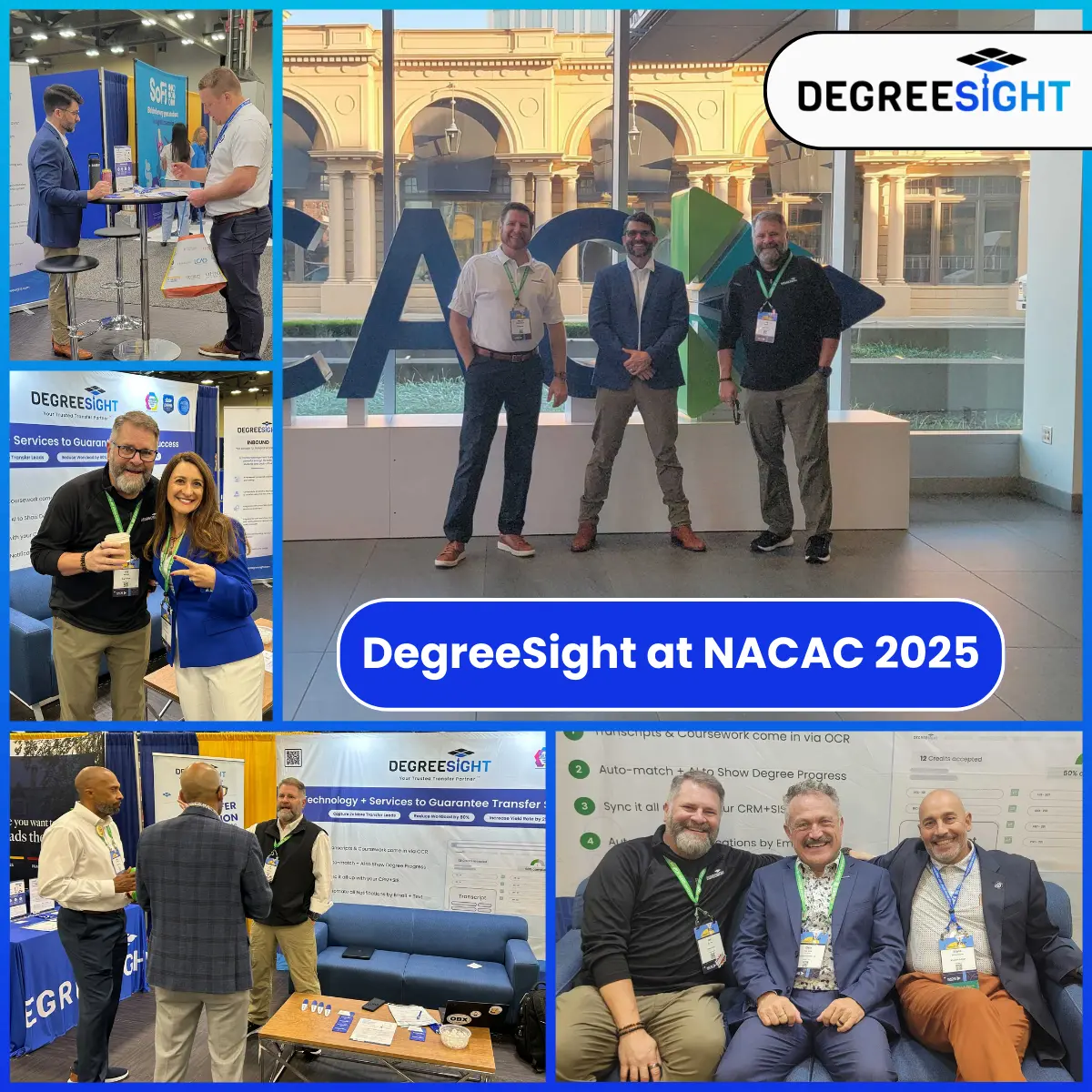
NACAC 2025 was more than just a gathering, it was a signal flare for what’s next in higher education. As thousands of admissions professionals, counselors, and edtech innovators converged in Columbus, Ohio, the message was clear: higher ed must evolve, and quickly.
Across dozens of conversations, DegreeSight team members identified five transformative themes. These aren’t just trends, they’re mandates for any institution that wants to thrive amid shrinking demographics, shifting student behaviors, and growing competition.
What You’ll Find in This Article
- The student-centered era has arrived, but staff burnout is real
- AI, OCR & behavior modeling are transforming enrollment operations
- Transfer students are now a strategic priority
- Your website is your most important enrollment tool
- The 2026 enrollment cliff is coming, and transfer is the lifeline
- Enrollment leaders must evolve into technologists
1. The Student-Centered Era Has Arrived, But Staff Burnout Is Real
According to Jay Fedje, VP of Partnerships at DegreeSight, a dominant concern across NACAC 2025 was this tension:
“How do we become more student-focused without overburdening our staff?”
As institutions look to elevate student services, especially around transcript evaluation, advising, and onboarding, they’re finding the limits of human labor. Many teams are still operating with manual processes, fragmented systems, and overloaded personnel. The result? Delayed responses, dropped prospects, and burnt-out staff.
This aligns with research from Inside Higher Ed showing that 65% of advising and admissions staff say they’re unable to meet student needs due to resource constraints.
NACAC attendees are now asking the right question: how can we deliver high-touch support at scale?
The answer echoed throughout the conference: technology-powered efficiency, done well.
2. AI, OCR & Behavior Modeling Are No Longer “Next”, They’re Now
Jay also noted surging interest in AI and OCR (Optical Character Recognition), particularly around:
- Automating transcript intake and credit evaluation
- Identifying prospective students based on behavior patterns
- Integrating web activity into CRMs for more predictive outreach
Tools that could automatically scan, interpret, and translate transcript data without human templates were in high demand.
“How can we identify which prospective students are most likely to enroll based on their digital behavior?”, a NACAC attendee asked us.
Solutions that combine AI with human oversight, like DegreeSight’s templateless OCR and predictive workflows, were particularly attractive because they scale without sacrificing accuracy.
3. Transfer Students: From Secondary Population to Strategic Priority
Woody Robertson, DegreeSight’s COO, summed it up:
“Even the top state schools don’t have great tools for processing transfer credit, and they know it’s costing them students.”
This year’s NACAC solidified that transfer students are no longer a peripheral focus. With over 74% of students entering college with some prior credit (per CCRC), institutions are racing to capture this high-intent, often-overlooked population.
At NACAC 2025, many attendees acknowledged that their current processes, manual evaluations, delayed responses, and unclear credit maps, are creating massive conversion friction.
This reinforces DegreeSight’s number 1 focus: Transfers Are the Most Underserved, Highest-Yield Enrollment Segment.
From instant equivalency to branded web calculators, colleges that simplify transfer are winning more students, and building trust earlier.
4. Your Website is Your Front Door. Make it Work Like One.
“How do we track website activity and use it in our recruiting funnel?” was also a common question at NACAC 2025.
Another key insight from Jay’s reflections: institutions are realizing their .edu websites need to convert, not just inform.
The need to bridge anonymous browsing behavior with CRM-driven engagement came up repeatedly. Schools want tools that:
- Identify high-intent behaviors (like credit exploration)
- Capture leads through interactive tools
- Sync seamlessly with CRMs like Slate or Element 451
This is the promise behind INBOUND, DegreeSight’s credit evaluation lead-gen product, which turns visitors into inquiries through transparent, student-friendly articulation estimates.
Want proof? See how Oklahoma Christian University turned 722 course submissions into 51 new inquiries using this strategy in their case study.
5. The 2026 Cliff Looms, Transfer Strategy Is the Lifeline
As Woody explained:
“Futurists have been warning us for years, and now the enrollment cliff is real. Institutions that wait will be too late.”
The projected demographic cliff of 2026, where the number of high school graduates declines sharply, has already begun shifting institutional priorities. Schools that once relied heavily on first-time, full-time freshmen are now looking to diversify enrollment sources, and transfers are the most viable option.
But capturing transfer students isn’t just about recruitment. It’s about:
- Fast, accurate credit evaluation
- Transparent web experiences
- Operational integration across registrar and enrollment
The institutions that solve these challenges now will be the ones still standing post-2026.
6. The Rise of Enrollment Technologists
In closing, Jay delivered a powerful message for institutional leaders:
“Enrollment managers must either find wise counsel, or become it. The future belongs to those who understand their tools.”
There’s a growing divide between institutions that treat edtech as a sidecar versus those who integrate it as a strategic pillar of operations.
What stood out at NACAC 2025 was the rising sophistication of enrollment teams. They’re not just looking for vendors, they’re seeking partners who help them navigate, implement, and evolve.
It’s why DegreeSight offers consulting alongside our software, helping institutions think through not just adoption, but transformation.
Final Takeaway
NACAC 2025 made one thing clear: the future of enrollment is strategic, student-centered, and tech-enabled.
Institutions that embrace transfer readiness, AI-supported processes, and digital-first recruitment will lead the next decade of higher education.
Those that don’t will fall behind.
Want to Stay Ahead of the Enrollment Curve?
Take our Transfer Friendliness Assessment
Understand where your institution stands and how to improve conversion.
Book a Strategy Call with Our Enrollment Advisors
Explore how to align registrar and enrollment operations.
See Case Studies from Schools Like Rogers State University, Indiana Wesleyan & Malone University
Real outcomes. Real enrollment growth.