

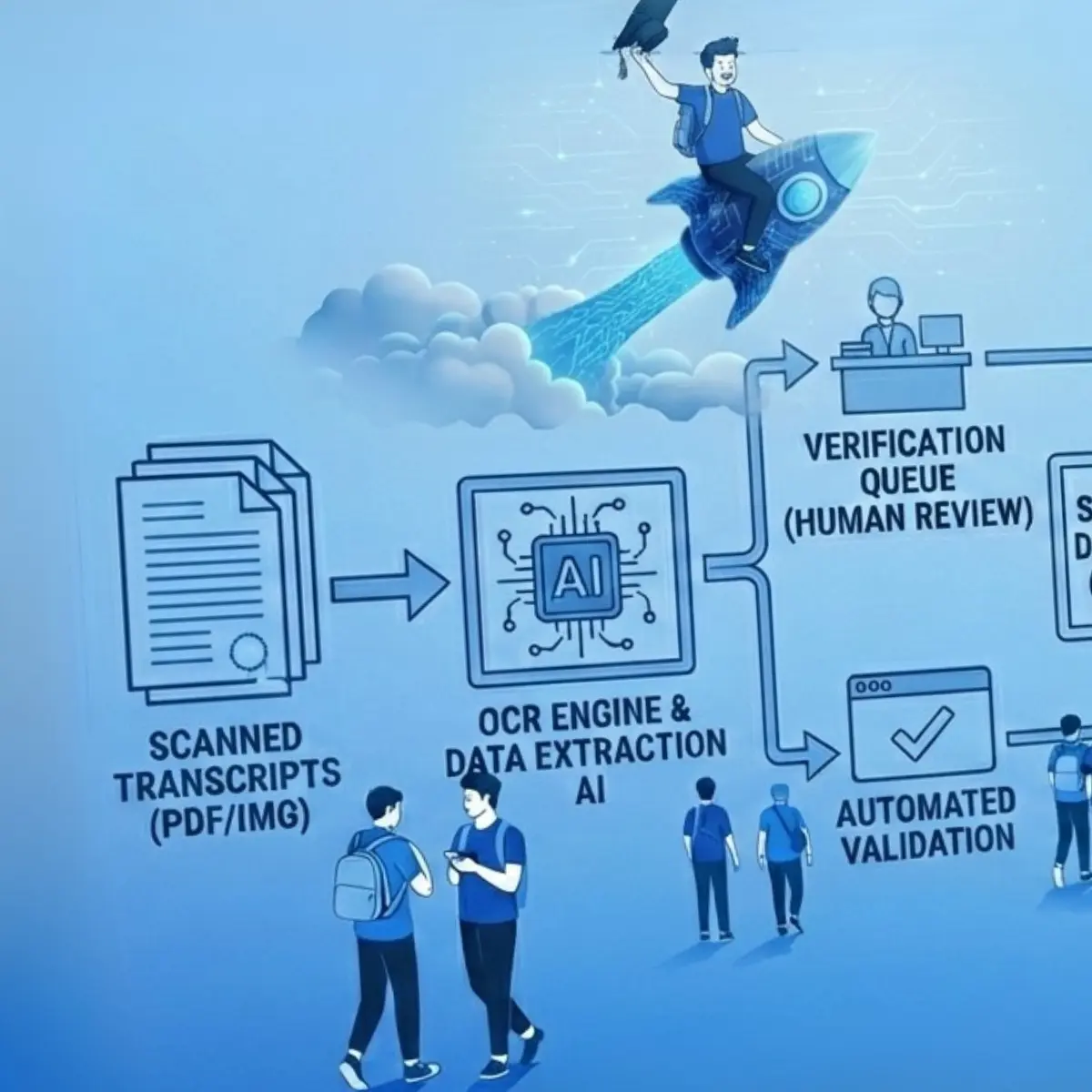
Most OCR tools can scan a document.
Very few can evaluate a transcript.
That distinction matters.
Transcript OCR for universities isn’t about reading text. It’s about turning academic history into registrar-grade decisions, accurately, quickly, and at scale.
DegreeSight’s approach was built specifically for higher education. Not adapted from invoice scanning. Not repurposed from HR software. Purpose-built for credit evaluation, articulation logic, and enrollment growth.
Here’s how it works, and why it’s different.
What You’ll Find in This Article
- Why generic OCR fails in higher ed
- How DegreeSight’s templateless OCR works
- From PDF to AI-scored evaluation in minutes
- Human-in-the-loop validation for registrar-grade confidence
- Why DegreeSight OCR drives enrollment, not just efficiency
1. Why Generic OCR Doesn’t Solve the Transcript Problem
Most OCR vendors stop at text extraction.
They scan a PDF.
They convert it into machine-readable text.
And then they hand you the data.
But transcript OCR for universities requires far more than text recognition.
Transcripts vary wildly in format:
- Semester vs. quarter systems
- Narrative vs. letter grading
- Institutional abbreviations
- International records
- Embedded transfer credits
Generic OCR doesn’t understand academic structure. It doesn’t apply equivalency rules. It doesn’t connect to enrollment workflows.
DegreeSight does.
2. Templateless OCR Built Specifically for Credit Evaluation
DegreeSight’s transcript OCR for universities is templateless and purpose-built for academic records.
That means it does not rely on static transcript templates. Instead, it uses AI-driven parsing trained specifically on higher ed transcript structures.
The system achieves up to 99% OCR accuracy, extracting:
- Institution name
- Course codes and titles
- Credit hours
- Grade values
- Term data
But extraction is only step one.
Unlike standalone OCR tools, DegreeSight immediately connects parsed data to:
- Institutional equivalency rules
- Articulation databases
- Rules engines
- SIS and CRM connectors
The output doesn’t sit in a viewer.
It becomes decision-ready data.
3. From Scan to Decision: Minutes, Not Months
Historically, transcript processing has created months-long backlogs.
Manual entry.
Spreadsheet cross-referencing.
Registrar overload.
DegreeSight changes the velocity equation.
From PDF upload to prioritized, AI-scored evaluation happens in minutes — while competitors are still keying grades into spreadsheets.
Institutions using DegreeSight report:
- 50% faster transcript processing
- 2x more transfer leads
- 25% higher yield rates
With DegreeSight 3.0 and bulk OCR functionality, high school transcript evaluations can be accelerated by up to 90%.
This isn’t just automation.
It’s acceleration with measurable ROI.
4. AI-Powered Course Matching + Human Validation
Automation without oversight creates risk.
That’s why DegreeSight’s transcript OCR for universities combines:
- AI-powered course equivalency matching
- Rules-based policy enforcement
- Human-in-the-loop validation
The AI identifies likely course matches using institutional articulation logic.
The rules engine applies transfer policies consistently.
Human reviewers verify flagged exceptions and edge cases.
The result?
Registrar-grade decisions delivered at digital speed.
AI does the heavy lifting.
Humans ensure academic integrity.
5. Integrated With Enrollment Strategy, Not Just Back Office
Here’s where DegreeSight fundamentally separates itself.
Most OCR vendors treat transcript processing as an operations problem.
DegreeSight treats it as an enrollment growth lever.
Transcript OCR feeds directly into:
- Student-facing Transfer Credit Calculators
- CRM workflows (HubSpot, Slate, Salesforce)
- Automated lead capture sequences
- SIS integration
- Enrollment dashboards
That means every transcript upload can trigger:
- Immediate credit previews
- Automated counselor follow-up
- Lead scoring and prioritization
- Faster offer generation
Where competitors stop at evaluation, DegreeSight’s transcript OCR for universities drives enrollment: more leads, faster offers, higher yield.
OCR becomes a front-of-funnel growth engine, not just a cost center.
6. The “Amazon Time” Standard
Today’s students expect immediate answers.
When a transfer student uploads a transcript, they don’t want to mail paperwork and wait weeks. They want clarity now.
DegreeSight’s OCR platform allows institutions to meet that expectation without adding staff.
Instead of limiting evaluation to application or admission stages (because volume is too high), institutions can move transcript clarity to the very top of the funnel.
That shift changes enrollment behavior.
Students apply with confidence.
Admissions teams move faster.
Registrars reduce backlog.
Speed builds trust.
7. The Competitive Differentiator
In the OCR market, many providers offer document scanning.
DegreeSight offers transcript OCR for universities that is:
- Purpose-built for credit evaluation
- Integrated with institutional rules engines
- Connected to CRM/SIS workflows
- Designed to increase transfer yield
- Backed by AI + human validation
This is why DegreeSight ranks #1 for “OCR transcript solutions.”
Because it doesn’t stop at extraction.
It turns every transcript into a real enrollment opportunity.
OCR as an Enrollment Multiplier
Transcript OCR for universities should not be a quiet operational tool hidden in the registrar’s office.
It should be:
- A transparency engine
- A speed advantage
- A workload reducer
- A yield driver
DegreeSight’s templateless OCR transforms transcript evaluation from a manual bottleneck into a strategic growth lever.
From PDF upload to prioritized decision in minutes, while maintaining academic integrity.
That’s not just faster processing.
That’s enrollment acceleration.
If you’re evaluating transcript OCR for universities and want to see how automation can drive both operational efficiency and enrollment growth, start with a Transfer Friendliness Assessment. We’ll identify where transcript speed can directly impact your yield.