
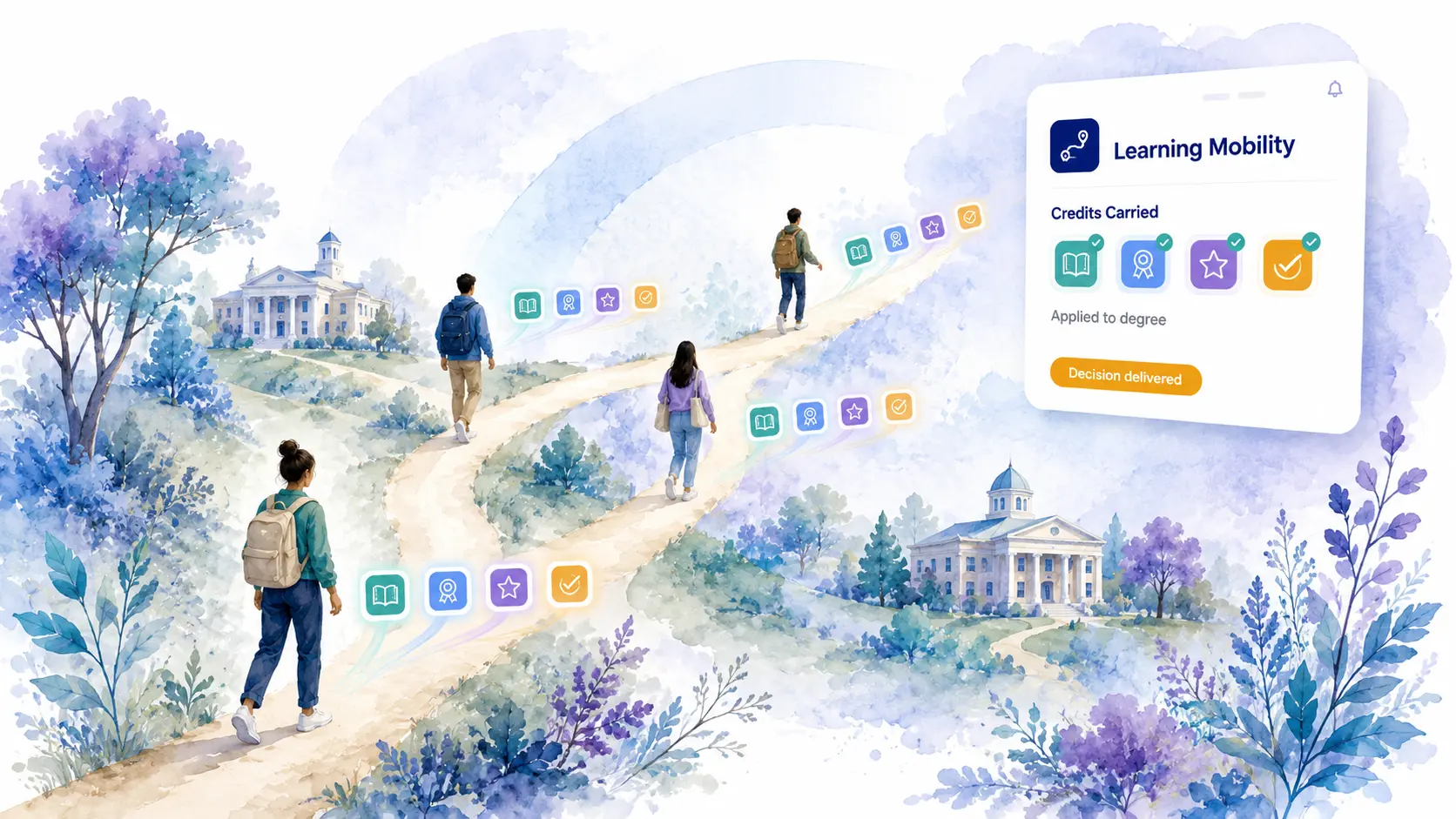
Learning mobility was the phrase that kept surfacing at AACRAO’s The Assembly this July, and that was not an accident. Learning mobility has replaced transfer as the organizing language of the conference formerly known as Technology and Transfer.
Jay co-presented with Texas Christian University on their use of our platform. Michael worked the sessions, the Ask Me Anything blocks, and the speed demos. Neither of them came home talking about software. They came home talking about a vocabulary shift, and about one number AACRAO has turned into a national learning mobility challenge.
What You’ll Find in This Article
- Why AACRAO retired “transfer” as its framing and what learning mobility actually covers
- The two-pronged enrollment pressure that arrives as one pile of paper on the registrar’s desk
- How transfer time to decision became the field’s shared benchmark in 2026
- Why “are we transfer friendly?” is the wrong question to ask your team
- Seven questions for an honest learning mobility self-assessment you can run this month
- What made The Assembly structurally different from every other conference this season
What Learning Mobility Actually Means
Michael noticed the term before he noticed anything else. “It really does signal a shift,” he said. “We used to talk about transfer in a very narrow way.”
Narrow is the right word. Transfer, as a term, carries a linear assumption: community college to four-year institution, one handoff, one direction. Learning mobility describes what students actually do. They move between multiple institutions. They stop out and return. They arrive carrying credit for prior learning, military credit, credit by exam, workforce credentials, and stackable microcredentials.
“Students need the ability to move between systems and learning experiences, carrying their credits, their credentials, their prior learning with them without loss and without repetition,” Michael said. That is the learning mobility definition worth writing down. It centers the learner instead of the institution. It treats movement as something to facilitate rather than an exception to manage.
The distinction matters operationally, not just philosophically. If transfer is an exception, you staff for exceptions. If learning mobility is the norm, you need infrastructure. AACRAO clearly believes it is the norm. The association now runs a Learning Mobility Lab, and The Assembly is that community’s annual summit. You will also see it written as learner mobility. The underlying idea is the same.
Learning Mobility Pressure Arrives From Two Directions
Jay described a split that will sound familiar to anyone running an enrollment shop right now.
“There’s this two-pronged approach that enrollment has,” he said. “I’m going after more transfers, trying to figure that out. And the other is, oh my gosh, we’re getting so many more students with college credit, and most of them are coming out of high school.”
One prong is intentional. Somebody wrote a strategy, set a goal, and assigned a target. The other prong is entirely responsive, and no one on campus controls the volume. Dual enrollment has nearly doubled over the past decade, from roughly 1.4 million students to more than 2.8 million in 2023 to 2024. High school students now account for more than one in five community college enrollments.
That growth is not slowing. Dual-enrolled students drove 38.4 percent of community colleges’ fall 2025 enrollment growth. Spring 2026 undergraduate enrollment reached 15.5 million. The fastest growth of any segment, up 5.5 percent, came from two-year institutions built explicitly for students to transfer out. Learning mobility is no longer a niche pipeline. It is the growth pipeline.
Here is the part that gets missed. Those two prongs feel like separate initiatives in a cabinet meeting. On the registrar’s desk they are identical.
“Both of them on that end look the same,” Jay said. “They look like students that had to get processed in a certain valuation. It doesn’t matter what their age is. It could be 17 years old. It could be 28. It could be 20. It is just a group of transcripts that a student’s plunking down on a desk and saying, help me figure this out.”
That single observation explains why learning mobility is a more useful frame than transfer. The work does not sort itself by student type. It sorts by volume.
One Number Became the National Learning Mobility Benchmark
The Assembly centered on a single metric this year: transfer time to decision. AACRAO built its National Learning Mobility Challenge around it, in partnership with NASH’s Center for Postsecondary Improvement. The association is now assembling the first national dataset on how long institutions take to move a transfer application from submission to decision.
Michael put the stakes plainly. “Every day a prospective transfer waits for that credit decision is the day a competing institution comes to scoop them up.”
That framing turns a learning mobility operations metric into an enrollment metric. Slow, opaque credit evaluation is not a service problem to apologize for at the end of a cycle. It is the leading cause of transfer melt, and melt is lost revenue.
What makes the Challenge notable is that it asks institutions to report their own baseline. Most schools have never measured time to decision as a discrete number. They know their application volume and their yield. They rarely know the median days between a completed transfer file and an answer the student can act on. If you cannot state that number, you cannot improve your learning mobility performance, and you cannot benchmark it against peers.
Transfer Friendliness Is a Scale, Not a Yes or No
The most useful reframe of the week came out of Jay’s session, and Michael sharpened it afterward.
“Institutions tend to not put an accurate definition on transfer friendliness,” Michael said. “The question really isn’t if you can evaluate credit well. At the end of that process, we can get something accurate into a student’s hand. The question is whether you are deciding fast enough on those equivalencies to enroll the student before they go elsewhere.”
Jay made the same point from a different angle. “Colleges think it’s a yes or no. Are you or aren’t you? And if they get transfers, then they must be transfer friendly.” He sees learning mobility as a scale instead. Low end, middle, high end, with a defined path to move up.
Both men also flagged a trap worth naming. Several institutions arrived at The Assembly convinced they had already solved learning mobility. They had bought a tool, or built one internally, and considered the box checked. In more than a few cases that tool was answering a different question than the one enrollment needed answered. In others, the homegrown system had quietly stopped keeping pace with volume. Confidence in a solution is not evidence it is working. The transfer numbers tell the truth.
Seven Questions for an Honest Learning Mobility Self-Assessment
Most enrollment leaders will tell you their institution is transfer friendly. Very few can produce evidence. These are the learning mobility questions Jay and Michael would ask first, and you can run them internally this month without talking to a vendor.
- What is your median number of days from a completed transfer application to a credit decision the student can act on? Not your best case. Your median.
- How many prospective transfer students requested an evaluation last cycle and never enrolled with you? That gap is your melt.
- Can a prospective student see how their credits would apply before they apply, or only after they are admitted?
- Who owns the equivalency decision, and how many people does one unusual course have to pass through?
- Read your transfer pages the way Jay does. Sort every message into transactional or transformational. Transactional copy covers deadlines, forms, process, and requirements. Transformational copy covers why a student would want to be here: testimonials, student stories, outcomes, personas. Most institutions are almost entirely transactional. “It’s a little bit like going on a date and asking about someone’s taxes,” Jay said, “as opposed to what do you like to do on the weekends.”
- Does your evaluation workflow connect to the systems you already run, or does it sit in a corner requiring manual re-entry?
- Can you answer questions one and two with data, or are you estimating? If you are estimating, that is your first project.
Question seven is the one that stings. Institutions that cannot measure their own learning mobility performance are managing it on instinct.
What Made The Assembly Structurally Different
Michael has been to a lot of conferences. This one, he argued, was built differently.
“They really put a sharp focus on making the participants active collaborators,” he said. “They’re contributing to this national movement of learner mobility. They’re not passive participants like I see in most conferences.”
That showed up in the format. Ask Me Anything sessions replaced some traditional panels. Speed demos put six to eight people around a table instead of a hundred in rows. Project-based learning pods ran as multi-session threads across the full conference, each producing a real deliverable by the end.
Jay heard the same themes at the National Small College Conference and at a roundtable of presidents earlier in the season. Volume is up, teams are overloaded, and nobody has a clear path out. The Assembly’s contribution was structural. It asked attendees to co-design learning mobility responses rather than sit and listen to them.
The Real Learning Mobility Constraint Is Rarely the Software
Two objections came up repeatedly in sessions, and neither one was about features.
The first was integration anxiety. “There’s a lot of apprehension in adding software that doesn’t connect to current platforms,” Jay said. Attendees asked about Workday, PeopleSoft, and Banner by name. Their fear was reasonable. Another siloed tool that does not talk to the rest of the stack creates work instead of removing it. Any learning mobility investment has to prove it reads from and writes to the systems already in place.
The second objection was quieter and more human. Many of the people closest to the problem do not believe they can influence the decision.
“How can I influence the decision makers on my campus? I just sit at this little desk and do these evaluations,” Jay heard repeatedly. His answer was that every landslide starts with a pebble. Someone has to name the problem with data, find the right two or three people, and start the conversation. Learning mobility change rarely begins with a budget line. It begins with a credit evaluator who documents how long the queue actually takes.
Learning Mobility Is a Capacity Question Before It Is a Technology Question
The GAO found that transferring students lose an average of 43 percent of their credits. That finding is nearly a decade old, and the field has not moved it much. The reason is not indifference. It is arithmetic. Volume rose, headcount did not, and manual evaluation does not scale.
That is where learning mobility infrastructure earns its place. Automated transcript capture and evaluation, paired with human review on genuinely ambiguous cases, lets a small team answer a large pipeline quickly. At DegreeSight we built Inbound to compress the front of that process. We built Insight to let prospective students see how their credits apply before they commit. Roosevelt University shows what happens when the decision arrives while the student is still interested.
The strategic takeaway from The Assembly is not that a new term entered the vocabulary. It is that AACRAO gave the field a shared, measurable definition of learning mobility success. Transfer time to decision is now a number institutions will be compared on. Learning mobility is the frame that number sits inside. Institutions that measure it this year will have a year of improvement behind them before it becomes a public benchmark.
Speed is the learning mobility strategy. Everything else is downstream of it.
If your current process is creating friction in your enrollment funnel, a Transfer Friendliness Assessment can help identify where you are losing students, and how to fix it.