

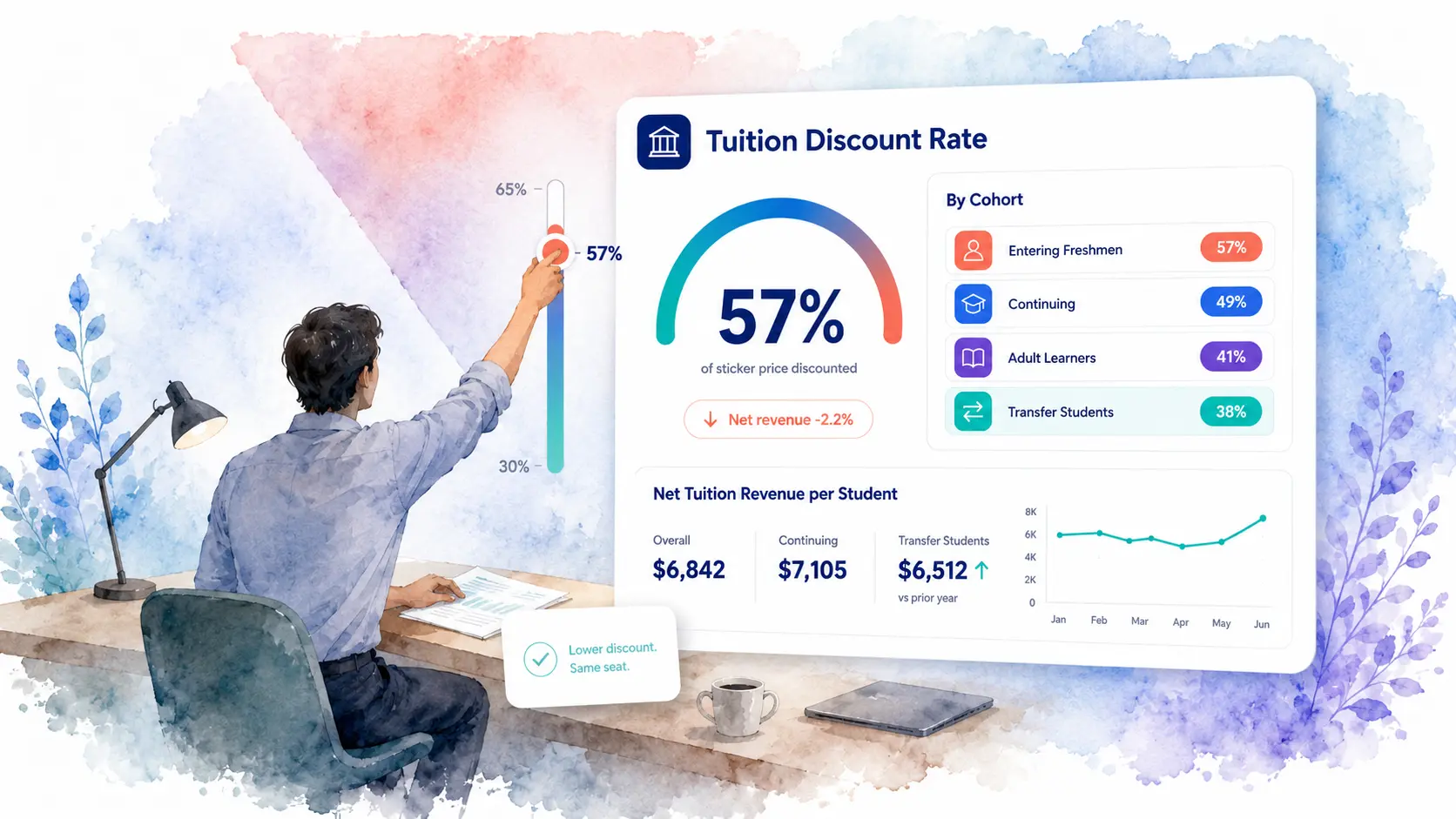
The average tuition discount rate at private nonprofit colleges is now estimated at 57.1 percent for first-time, full-time undergraduates. A tuition discount rate at that level is no longer a recruitment lever. It is the business model.
For every dollar of tuition an institution could have charged a new freshman, it gives back roughly 57 cents in institutional aid. And the trade is getting worse, not better. Net tuition and fee revenue per first-time, full-time undergraduate fell 2.2 percent after inflation in the most recent NACUBO study. Schools are buying more students with more money and collecting less per student.
We sat down with Charles Ramos, Vice President of Partnerships at DegreeSight, to talk through what CFOs actually control here. He spent 30 years in higher education enrollment before joining DegreeSight. His answer was not what most finance leaders expect.
What You’ll Find in This Article
- How the tuition discount rate is calculated, and what the number hides
- Why raising the tuition discount rate to chase volume becomes an inverted pyramid
- The two honest questions to answer before touching the tuition discount rate
- Why boards that cut the tuition discount rate too fast get the opposite result
- The population already enrolling 10 to 20 points below your freshman rate
- What credit clarity does to conversion, and what it does to net revenue
What the Tuition Discount Rate Actually Measures
The math is simple. The behavior underneath it is not.
“Every institution has their sticker price,” Ramos said. “Then the institution offers financial incentives and assistance based off of a series of factors.”
Merit awards go to academically strong students. Need-based institutional aid goes to families who cannot cover the gap. Both come out of the same pocket. Add all institutional dollars together, exclude government money, and divide by total tuition. That is your tuition discount rate.
Ramos has watched the number climb for three decades. “When I first got into higher education professionally, 30 years ago, we were looking at discount rate averages more in the high 30 percent range,” he said. “And now they’re approaching 50.”
The national figure has since passed that. What matters more is the spread underneath the average tuition discount rate.
Institutions with real demand still operate in the 30 to 35 percent range. People are willing to pay for them. Struggling institutions have pushed into the 60 to 65 percent range. The difference between those two groups is not financial sophistication. It is demand.
“What the school is trying to do is make it easier in regards to the ability to pay, rather than the willingness to pay,” Ramos said.
That distinction is the whole article. Willingness to pay is earned through program relevance and a clear value proposition. Ability to pay is purchased. One compounds. The other bleeds.
Why a High Tuition Discount Rate Becomes an Inverted Pyramid
Schools that push the tuition discount rate high are usually playing for time. Get volume now, toggle the tuition discount rate back later once the class is stable.
Ramos has seen how that ends.
“When you’re in the 60 to 65 percent range of discount rate for entering freshmen, it’s an inverted pyramid,” he said. “And that inverted pyramid can certainly fall on itself. Sometimes we’ve seen that with schools that have closed, where that strategy just doesn’t really take shape.”
The structural problem is that awards are rarely indexed to tuition. Tuition rises each year. The award does not. So the tuition discount rate for that cohort quietly declines as students move through, which looks like progress on a report. It is not progress. It is the same class paying a slightly larger share of a larger number, while the next entering class costs more to buy than the last one.
Financial aid leveraging models help schools optimize the trade. Econometric modeling tells you what each additional thousand dollars buys in enrolled students and net tuition revenue. Those models are useful. They are also bounded. They optimize the tuition discount rate inside one population, and that population is the most expensive one you enroll.
The Two Questions to Answer Before You Touch the Rate
Ramos does not start with the tuition discount rate. He starts with the product.
“A school needs to be very honest with themselves,” he said. The first question is whether the institution is providing a product the market wants. Are the programs aligned with market demand?
The second question is harder. Is the institution effectively communicating its value proposition to that market? Do prospective students understand the return on investment, the differentiators, and the reason to choose this school over the one down the road?
“If they can honestly say they are absolutely effectively doing that, then what you should find is that the market is going to have a greater willingness to pay,” Ramos said.
Only then does selective discounting make sense. Raise the tuition discount rate for specific sub-populations where you want to compete harder. A blanket tuition discount rate increase is not a strategy.
“Indiscriminately jumping in and just raising your discount rate to get more enrollment over too long a period of time is a dangerous game to play,” he said.
Why Boards Cut the Tuition Discount Rate Too Fast
The reverse mistake is just as expensive.
A board looks at a tuition discount rate in the mid-40s and decides it needs to come down. The instruction goes to enrollment. Enrollment tightens awards. The class shrinks.
“Don’t jump too fast, because you may get a result that is absolutely the opposite of what you want,” Ramos said. “You’re going to see enrollment go down. You have to know where that sweet spot is.”
A tuition discount rate is a symptom, not a dial. Cutting it without first fixing demand simply converts a revenue problem into an enrollment problem. The board gets a better ratio and a worse balance sheet.
The Population Already Enrolling at a Lower Tuition Discount Rate
Here is the part most finance conversations skip entirely.
“Transfers and adult undergraduate students typically don’t have as high of a discount rate,” Ramos said. “They’re typically 10, 15, 20 points lower.”
Read that against a 57 percent freshman benchmark. A transfer student enrolling at a 40 percent tuition discount rate contributes materially more net tuition revenue per year than a freshman enrolling at 57. Same seat. Same instruction cost. Different economics.
These students receive less institutional aid because fewer merit and need programs are built for them. That is a design choice, not a market condition. And it means the segment with the lowest tuition discount rate is usually the segment with the smallest marketing investment behind it.
The Four-Year Revenue Argument, Revisited
CFOs push back, and Ramos knows the script.
“I’ve had several CFOs tell me we want to concentrate really on the freshmen,” he said. “They’re coming in for four years. That’s four years of revenue opportunity.”
The four-year assumption does not survive contact with retention data. National first-year retention recently hit a decade high at 69.5 percent. Private nonprofit four-year institutions sit near 79 percent. That still means roughly one in five freshmen does not come back, and attrition continues every year after that.
So the four-year student is frequently a two-year student carrying a four-year tuition discount rate.
“If you can mitigate, if not sometimes even completely eradicate, the impact there with an effective, fully invested, optimized transfer and adult enrollment approach,” Ramos said, “and it’s compounded by the fact that they are coming in at a lower discount rate anyway, that impact is significant enough that it really can add huge benefits to the institution on a revenue perspective.”
There is a retention argument buried in the revenue argument. When a transfer student leaves, they usually do not go anywhere else. “If they drop out from your institution as a transfer, chances are they probably won’t be going anywhere else,” Ramos said. That is a mission failure and a revenue failure at the same time.
Credits Are Currency, and Clarity Is the Conversion Event
Adult and transfer students do not buy the campus experience. They buy outcomes.
“They’re looking for results. They’re looking for return on investment,” Ramos said. “And the first sign that you can show a return on investment is by providing them with a seamless, easy, expeditious experience.”
They want three answers. How many credits transfer. Which courses they map to. How much is left to finish.
Then Ramos named the fourth answer, the one that changes behavior.
“Those credits are currency to them,” he said. “The fact is that those credits actually equate to a dollar amount for which they’re now saving.”
A student who learns that prior credit saves them $85,000 has just been given a net price they can act on. No award letter required. No application required. That is a value proposition delivered before the institution has spent a dollar of discount on them.
This is where infrastructure changes the finance conversation. Tools like Inbound put real-time credit evaluation on the institution’s own website, and Insight shows the path to graduation. Students self-serve, and the institution captures them as leads in the CRM. Roosevelt University reported a 20 percent increase in transfer enrollment and a $764,000 increase in net tuition revenue.
That is net revenue growth without moving the tuition discount rate at all.
A Process That Has Not Changed Since 1992
The opportunity exists because almost nobody has taken it.
Ramos hears the same operational reality at every conference. Most institutions return credit decisions three to five weeks after a student submits a transcript. Many require an application first. Some deliver clarity only after admission.
“I’ve had two institutions tell me that students get clarity around what’s transferred and their path towards graduation after the first month that they’ve been enrolled,” he said.
A vice president of enrollment put it to him plainly. Transfer processing “is still the same as it was in 1992.”
Meanwhile the student is on your site at 9pm, after a full workday, deciding between you and three competitors. Three minutes of clarity wins that decision. Three weeks loses it. And it wins without a single point of added tuition discount rate.
What This Means for Your Revenue Strategy
The tuition discount rate is the most watched number in higher education finance and one of the least useful ones to manage directly. It reports the outcome of demand. It does not create demand.
The institutions that will hold their net revenue over the next five years are not the ones with the cleverest leveraging model. They are the ones that build genuine willingness to pay in the traditional market, then aggressively grow the populations that already enroll at a lower tuition discount rate. That second move costs infrastructure, not aid dollars, and it is the only lever that improves the ratio and the revenue at the same time.
Treating transfer and adult students as an afterthought is not a marketing oversight. At a 57 percent tuition discount rate, it is a financial strategy decision, and most institutions are making it by default.
If your current process is creating friction in your enrollment funnel, a Transfer Friendliness Assessment can help identify where you are losing students, and how to fix it.