

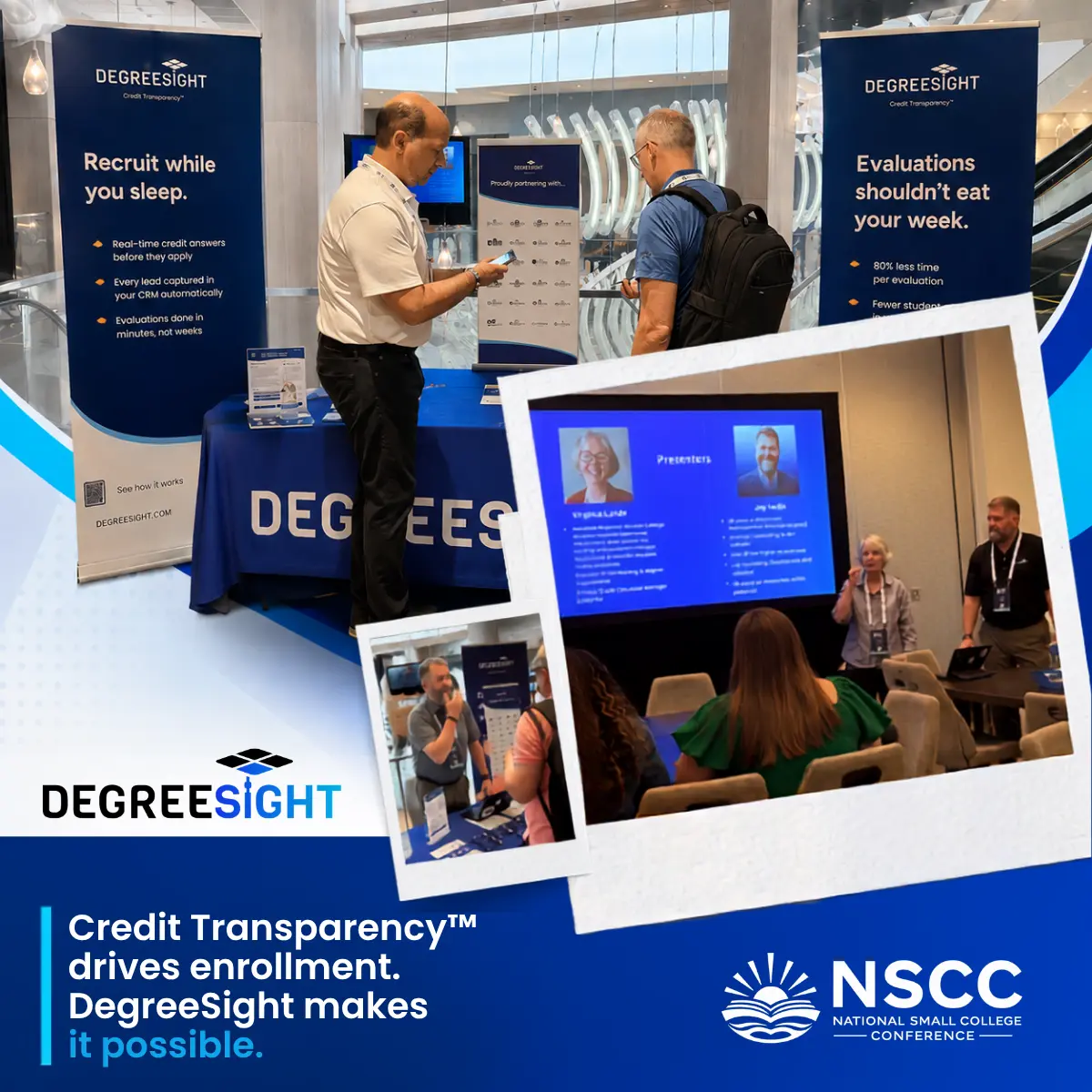
An enrollment growth strategy for small colleges cannot start and end with the freshman class anymore. That was the quiet consensus running under nearly every conversation at the National Small College Conference (NSCC), held July 14 through 16 in Charlotte, North Carolina.
DegreeSight VP of Partnerships Charles Ramos and Jay Fedje, spent the three days on the floor of the Charlotte Marriott City Center, splitting time between a well-placed booth and a run of one-on-one meetings. The audience was consistent: enrollment, marketing, and student success leaders from small colleges and universities across the country, institutions that tend to be tuition-driven, without national brand-name recognition, and light on the marketing budgets larger universities take for granted.
What stood out to Ramos was not the topic everyone expected to dominate the room. It was the topic that kept getting raised almost as an afterthought, and then landing like a discovery each time it came up.
What You’ll Find in This Article
- Why the enrollment cliff was the backdrop at NSCC 2026, not the headline
- The data behind why transfer and adult students are the only growth markets left
- How the commoditization of higher education is changing what students expect from enrollment
- Why credit transparency still isn’t on most institutions’ priority list, and what that costs them
- What it takes to get enrollment planning out of institutional silos
- What an enrollment growth strategy for small colleges should include now
The Enrollment Cliff Was the Backdrop, Not the Headline, at NSCC 2026
Every small college leader in that room already knows the shape of the problem. The number of college-age students is projected to decline by roughly 15 percent between 2025 and 2029, according to AGB’s analysis of the enrollment cliff, with the steepest drops concentrated in the Midwest and Northeast. The South and West see milder declines, but no region is exempt from a shrinking pool of eighteen-year-olds.
Ramos heard that anxiety in nearly every conversation, but he also heard something more specific. Truman State University president Susan Thomas spoke at the conference and framed the path forward around authenticity, telling attendees that the way for a small institution to stand out is to know itself and communicate that honestly rather than trying to out-market larger competitors on their terms.
“I think it’s great to be able to make sure that each and every one of the institutions represented there is thinking about how to optimize their ability to convey their value proposition,” Ramos said, reflecting on the session. “How is it that we can take market share from others who’ve owned that market share for some time, and build sustainable enrollment growth when you’re dealing with a never-growing market?”
That question, sustainable growth inside a shrinking traditional pool, is where the real conversation started. And according to Ramos, it is also where most small colleges are still looking in the wrong place.
Why Transfer and Adult Students Are the Only Growth Left
Ramos was direct about the blind spot. Small colleges are, in his words, “absolutely predominantly, if not almost solely, tuition driven,” and that dependency pulls nearly every resource toward the traditional four-year freshman. That population still shapes institutional rankings, still defines the four-year experience the institution is built around, and still receives the overwhelming share of marketing and financial aid investment. The instinct at most colleges, Ramos said, is to just do the same recruiting playbook better rather than open up new markets.
The problem is that the freshman-focused playbook is optimizing for a market that is actively shrinking. Meanwhile, transfer and adult students represent the only enrollment segments still growing.
What the Data Shows
The numbers back this up. Transfer enrollment grew 4.4 percent between fall 2023 and fall 2024, and transfer students now make up 13.1 percent of all continuing and returning undergraduates nationally, up from 11.9 percent in fall 2020, according to the National Student Clearinghouse Research Center. Two-to-four-year transfers account for the largest share of that growth, and institutions with high transfer volume, nearly half of all public two-year enrollment, saw the biggest gains of any sector.
“The transfer and adult population are the growth populations right now,” Ramos said. “That’s the only population that’s growing, and it has potential for continued growth, versus the cliff hitting the traditional student.”
Yet when Ramos asked enrollment leaders directly whether transfer credit evaluation factored into their growth plans, the answer was almost always the same: it is somewhere on the list, just further down than it should be. Not because leaders disagree with the logic. Because the traditional freshman has always been the focus, and shifting that focus takes more than one conversation at a conference booth.
Higher Education Has Become a Commodity, and Students Are Shopping Like It
The second theme Ramos kept hearing was less about demographics and more about behavior. Across every population he discussed at NSCC, traditional, transfer, or adult, the same expectation kept surfacing: students now treat their education the way they treat any other major purchase, and they expect the enrollment process to reflect that.
“There’s been a commoditization of higher education,” Ramos said. “And when one considers anything to be a commodity, there’s a different set of expectations placed on it.” He described students wanting expediency, wanting to get in, get through, and get out, and wanting clarity on what the return on that investment will actually be.
National research supports what Ramos heard on the ground. Public confidence in higher education has fallen from 57 percent in 2015 to 42 percent in 2025, according to the Lumina Foundation’s 2026 research on the gap between public perception and student experience. At the same time, 57 percent of current students say four-year institutions are not charging fair prices, even though the overwhelming majority still believe the investment is ultimately worth it. Students are not abandoning belief in the value of a degree. They are demanding proof of that value earlier, and they are pricing the enrollment experience itself into that judgment.
Ramos put it plainly: the enrollment process is a preview. “If it is laborious, if there’s a lot of friction, if it ends up taking a lot of time, all they see is, ‘this is going to be how it is once I’m a paying customer’.” A slow, opaque process at the front door does not read as a minor inconvenience. It reads as a forecast.
Credit Transparency™ Is Still an Afterthought, and It Shouldn’t Be
This is where the enrollment cliff conversation and the commoditization conversation collide. Credit transparency sits at the intersection of both problems, touching the fastest-growing enrollment segment and the expectation reshaping how every segment shops.
Yet by Ramos’s account, it rarely comes up unprompted. It surfaces only when someone raises it directly, and then the reaction is recognition rather than resistance. “It was almost as if, like, ‘aha, I’ve, that’s actually a good point. Yes, we need to look at that’,” Ramos said, describing how the conversation shifted once credit transparency entered the discussion at the DegreeSight table.
Part of the reason is structural. Higher education has historically reacted to demonstrated interest rather than reaching students earlier in their decision-making. “We react, meaning higher ed reacts to the population having already taken a step that shows some level of proclivity toward the institution,” Ramos said. He described the opportunity in terms of a bell curve: institutions chase the thin slice of prospects who have already shown intent, while a much larger group, students still comparing options and researching credit transfer on their own time, goes largely unaddressed. That includes the students researching institutions after nine to five, when most enrollment offices have gone home for the day.
Institutions that move credit evaluation earlier in the funnel change that dynamic. They give a prospective student, not just an applicant, a real answer before the student has to commit to finding out. DegreeSight has written before about why the transcript evaluation process still slows down enrollment, and the pattern Ramos described at NSCC lines up with that research closely. Transparency is not a back-office fix. It is a front-door recruiting tool.
An Enrollment Growth Strategy for Small Colleges Starts by Breaking Silos
The hardest question Ramos fielded at the conference was not about data. It was about authority. If an enrollment leader sees the opportunity in transfer and adult populations, who actually has the power to act on it?
Ramos did not minimize the challenge. Institutions that try to expand beyond the traditional freshman market often get redirected by leadership whose mindset is still built entirely around the entering freshman, whether that pushback comes from the president, the CFO, or the board. “I think you’re right in terms of that there’s some that have been hindered at times,” Ramos said, “or at least progress, even for those who intend to expand the markets they’re looking at, tends to get rerouted by leadership.”
His answer was not to escalate a single request up a single chain of command. It was to get the vice president for enrollment, the registrar, financial aid leadership, and the CFO into the same room, working from a shared enrollment plan rather than separate departmental priorities. “These are all individuals that need to sit at the same table and really start to process and develop a much more strategic enrollment-minded platform,” Ramos said, describing a plan that looks at enrollment with a capital E, meaning every revenue stream and every population, rather than a lowercase e that only concentrates on incoming freshmen. Without that, he said, institutions stay siloed in conversation, mentality, strategy, and operations, and enrollment stays capped at whatever the freshman market alone can deliver.
DegreeSight has covered this dynamic in the context of transfer pipelines specifically. As outlined in how to stabilize a transfer pipeline, the fragmentation Ramos describes at the leadership level tends to mirror the fragmentation in the transfer process itself. Fixing one without the other rarely holds.
What an Enrollment Growth Strategy for Small Colleges Should Include Now
None of what Ramos heard at NSCC 2026 suggests small colleges should abandon their focus on traditional students. The four-year freshman is still central to institutional identity and, for most of these schools, still the largest share of tuition revenue. What the conference made clear is that treating the freshman market as the only market is no longer a viable enrollment growth strategy for small colleges inside a shrinking demographic pool.
Three things kept surfacing across Ramos’s conversations in Charlotte. First, institutions need a genuine read on the markets they are already serving without realizing it, including traditional students arriving with dual credit who never get asked about their credit picture until they are sitting across the table. DegreeSight has explored this blind spot in whether transfer evaluation is the answer to the demographic cliff. Second, enrollment planning has to move out of departmental silos into a shared strategy that treats transfer and adult students as core populations, not side projects. Third, credit transparency needs to move earlier in the funnel, reaching stealth prospects before they apply, not after.
Ramos was clear that institutions do not need to guess where they stand on any of this. “The opportunity to be able to help institutions understand where they are right now, what their current state is versus what the desired state should be, is imperative in terms of being able to succeed,” he said.
Small colleges spent three days in Charlotte talking about a shrinking market. The more useful conversation, the one that kept surprising people at the DegreeSight table, was about the market that is already growing and still waiting to be noticed.
Curious where your institution stands? Get your Transfer Friendliness Assessment and see exactly where transcript delays, workflow gaps, and website friction are costing you enrollment.