
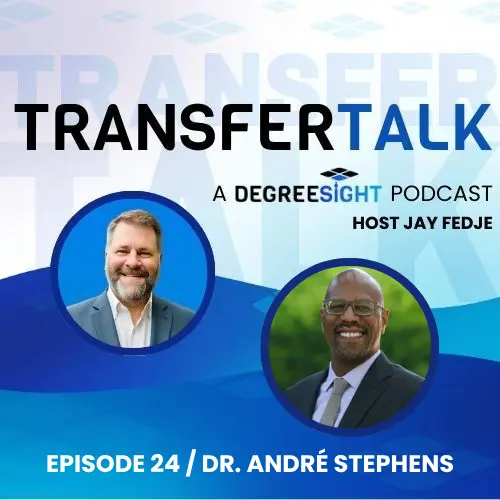
With Dr. André Stephens, President of Fresno Pacific University
Higher education isn’t just facing disruption, it’s being redefined in real time.
In this episode of TransferTalk, Dr. André Stephens offers a rare, behind-the-scenes look at what it takes to lead an institution through enrollment decline, financial pressure, and cultural transformation, all while keeping students at the center of every decision.
From Admissions to the Presidency
Dr. Stephens’ path to the presidency at Fresno Pacific University didn’t follow the traditional academic route.
Instead, it started in admissions, on the front lines of student recruitment, and evolved through student development and executive leadership.
That foundation shaped how he sees the institution today:
“Without students, we would not be here. Our job is to help them flourish and thrive.”
This perspective reframes leadership, not as policy-first, but as student-first strategy.
Student-Centered Leadership Is Not a Slogan
Many institutions claim to be student-centered. Few operationalize it.
For Stephens, student-centered leadership means:
- Removing barriers to access and completion
- Aligning decisions with student outcomes
- Viewing student success as institutional success
“Our students’ success is our success, and their failure is our failure.”
This mindset becomes especially critical during moments of crisis.
Leading Through Disruption Requires Hard Decisions
When Stephens stepped into the presidency, Fresno Pacific faced:
- Significant enrollment decline
- Millions in lost revenue
- Rising operational costs
The response wasn’t theoretical, it was immediate and decisive.
Key actions included:
- Restructuring the leadership team
- Making program and budget cuts
- Rebuilding institutional vision
- Increasing transparency across stakeholders
But what stands out most isn’t just the decisions, it’s how they were made.
Presence Builds Trust Faster Than Messaging
In moments of tension, many leaders retreat.
Stephens did the opposite.
He showed up:
- Meeting with students, faculty, and staff
- Engaging directly with critics, even during protests
- Listening before acting
“In times of crisis, people turn inward, but leadership requires being present.”
This approach builds trust in ways that messaging alone never can.
Strategy That Actually Gets Used
One of the most practical insights from the episode is Stephens’ rejection of traditional strategic planning.
Instead of long, static documents, Fresno Pacific uses focused, short-term strategic priorities.
“Most strategic plans aren’t strategic, they just sit on a shelf.”
By narrowing focus and emphasizing execution, the institution creates:
- Clarity across teams
- Accountability in leadership
- Momentum in change efforts
Leadership in Higher Ed Is Becoming Collaborative
Stephens makes it clear: the future of leadership is not siloed.
“The ecosystem is complex, everything is connected.”
Successful leaders today must:
- Collaborate across departments
- Lead with openness and adaptability
- Balance expertise with humility
It’s no longer about individual authority, it’s about collective impact.
The Role of “Why” in Leadership
At the core of Stephens’ leadership philosophy is a simple but powerful idea:
Know your “why.”
For him, that “why” is deeply personal, rooted in his own experience as a student and his belief in education as a transformative force.
“When I saw the students, I saw myself, and I saw potential.”
That clarity of purpose becomes the anchor for every decision, especially the difficult ones.
The Big Takeaway: Enrollment Strategy Is Institutional Strategy
This episode reinforces a critical shift:
Enrollment is no longer a function, it’s the foundation of institutional survival and growth.
Leaders who understand:
- student behavior
- enrollment dynamics
- the full student journey
…are better equipped to navigate disruption and build sustainable institutions.
Because in today’s landscape, being student-centered isn’t optional, it’s strategic.
Listen Now
This episode is a must-listen for presidents, enrollment leaders, and anyone navigating institutional change in higher education.
👉 Listen to Episode 24 of TransferTalk
Is your institution truly student-centered—or still operating in silos that create friction?
Take the Transfer Friendliness Assessment (TFA) and uncover where your strategy stands.