
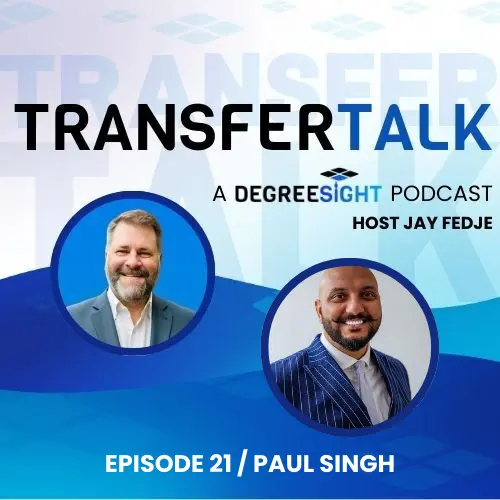
With Paul Singh, Associate Director of Relations at Phi Theta Kappa
Transfer students are no longer navigating higher education blindly. They’re informed, strategic, and increasingly selective about where they enroll.
In this episode of TransferTalk, Paul Singh from Phi Theta Kappa (PTK) brings a national perspective on how transfer culture is evolving. With more than 1,200 community college chapters and 800 four-year partners, PTK sits at the center of one of the largest transfer ecosystems in the country.
From dual enrollment expansion to adult learners returning to finish degrees, Singh explains why today’s students are shopping for credit-friendly institutions—and why colleges that fail to respond risk being left behind.
Transfer Students Are Shopping Smarter
Today’s transfer students behave more like consumers than ever before.
They compare institutions carefully and prioritize three core questions:
Where should I apply?
How much will it cost?
How many of my credits will transfer?
Students want those answers immediately.
According to Singh, the credit conversation has become the deciding factor for many students choosing between institutions.
“Students are selective. They want to know exactly how their credits transfer and where their degree path will take them.”
This shift means institutions must rethink how they communicate transfer policies and credit evaluation processes.
Credit Loss Is Still the Biggest Barrier
For transfer students, credits represent more than coursework—they represent time and money already invested.
When credits don’t transfer, students see it as a direct financial loss.
“Credit is currency. When credits don’t transfer, that’s money left on the table.”
While scholarships are helpful, Singh notes that many students would rather transfer more credits than receive additional financial aid.
The takeaway is simple: institutions that maximize credit mobility gain a powerful recruiting advantage.
Dual Enrollment Is Reshaping the Definition of “Transfer”
Another major trend Singh highlights is the explosive growth of dual enrollment and early college credits.
High school students are now graduating with associate degrees or large numbers of college credits already completed.
That shift is blurring the line between freshmen and transfers.
The traditional categories are breaking down. A student may arrive on campus at 18 years old but already have the academic profile of a junior.
Colleges that fail to adapt their transfer strategies to accommodate these students risk missing a major pipeline of future enrollments.
Adult Learners Are Returning in Large Numbers
PTK is also seeing a surge in adult learners returning to college.
Many of these students started degrees years ago but left due to work, family responsibilities, or life changes. Now they’re returning with a clearer sense of purpose—and higher expectations for how institutions handle prior learning.
These students often bring:
multiple transcripts
professional experience
certifications or prior learning credits
Institutions that evaluate these experiences thoughtfully can unlock significant enrollment opportunities.
The Coming Revolution: Instant Clarity
Looking ahead, Singh believes the next major shift in higher education will be radical transparency in credit evaluation.
Students increasingly expect to know exactly how their credits apply before they even apply to a school.
“Students will expect instant clarity—knowing where their credits apply before they apply.”
Technology and automation will make this possible, but institutions must also update the underlying policies that determine how credits transfer.
The schools that move fastest toward real-time credit visibility will become magnets for transfer students.
The Real Solution: Listen to Students
For Singh, the most important advice for enrollment leaders is surprisingly simple.
Talk to transfer students.
Focus groups, student stories, and direct conversations reveal the real barriers that data alone cannot show.
“The solution lies within the problem. When you listen to students, they’ll tell you exactly what needs to change.”
Institutions that combine student insight, transparent policies, and modern technology will lead the next era of transfer success.
Listen Now
This episode is a must-hear for enrollment leaders, registrars, and anyone working to improve transfer pathways.
👉 Listen to Episode 21 of TransferTalk
Take the Transfer Friendliness Assessment (TFA)
Is your institution truly transfer-friendly—or just checking a box?
Take the Transfer Friendliness Assessment (TFA) to evaluate your policies, processes, and student experience.